
Explosion and Impact Test Building
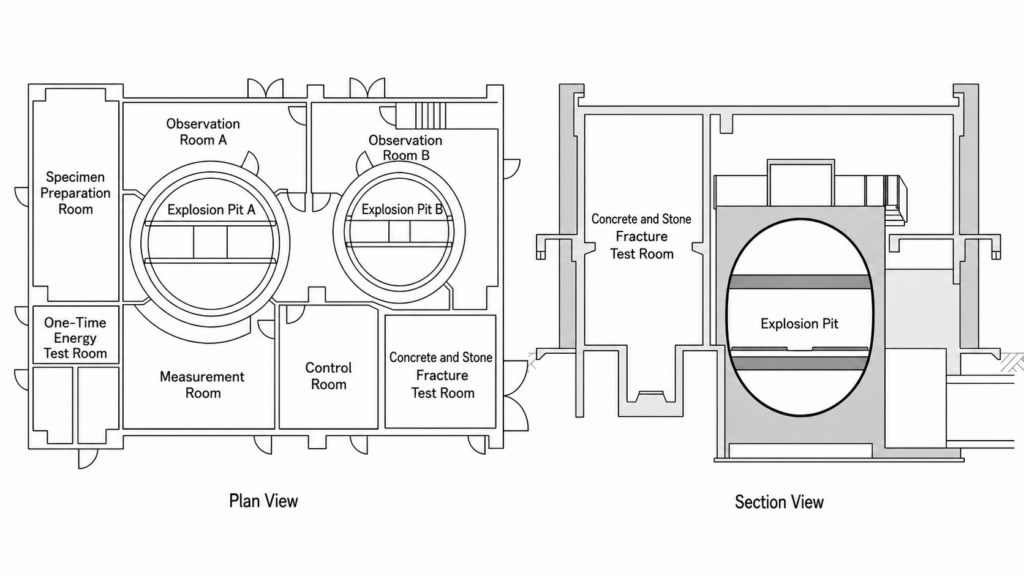
This facility is the only one of its kind among Japan’s national universities capable of conducting comprehensive explosion and impact experiments using energetic materials. It houses two explosion pits. Explosion Pit A is used for experiments involving high-speed visualization and various measurements, while Explosion Pit B is used mainly for specimen recovery experiments. Up to 2 kg of energetic materials may be used in a single experiment in either pit. Explosion gases generated in the pits are treated by an exhaust system equipped with scrubbers before being discharged outdoors.
The One-Time Energy Test Room is available for various experiments using less than 1 g of energetic materials. The Concrete and Stone Fracture Test Room is equipped with a 2.8-ton crane and an underground experimental space, enabling fracture experiments on heavy objects and large specimens.
Visualization and Measurement
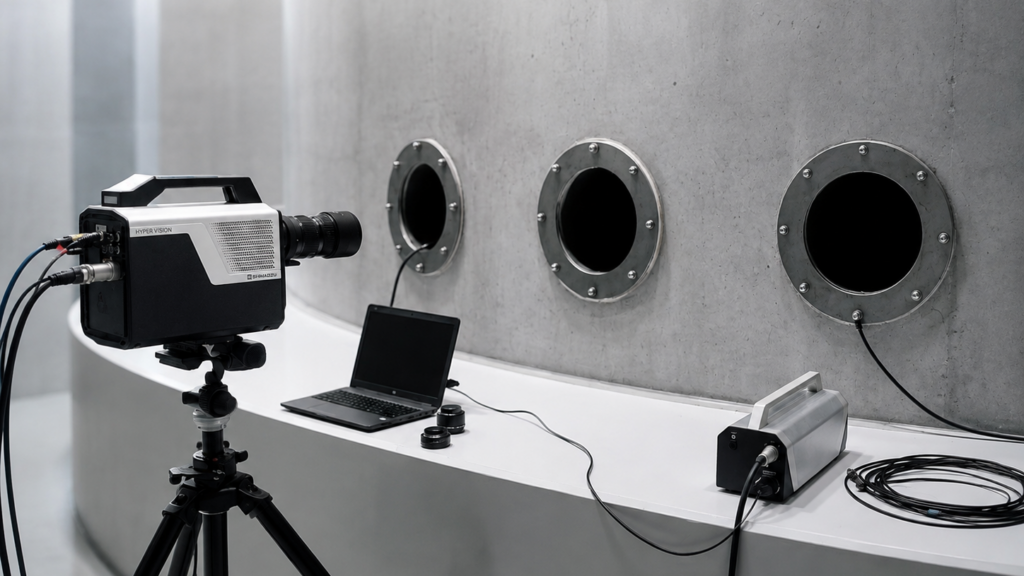
Explosion Pit A has multiple observation ports, allowing explosion and impact phenomena to be observed safely from the adjacent measurement room. The photograph shows a high-speed camera installed in the measurement room and the observation ports leading into Explosion Pit A.
For high-speed imaging, we use Shimadzu HPV-X2 and HPV-1 cameras, together with a Phantom V7.2 camera capable of color imaging. The HPV-X2 can record up to 256 consecutive frames at a minimum interframe time of 100 ns, while the HPV-1 can record up to 100 consecutive frames at a minimum interframe time of 1 μs. These cameras are used to observe extremely rapid phenomena. The Phantom V7.2 is used to record phenomena occurring over several milliseconds or longer. The recorded images can be analyzed using digital image correlation (DIC) and image-based temperature analysis, enabling the time-resolved evaluation of displacement, strain, and temperature distributions associated with high-rate deformation.
Our lighting systems include a Cavitar CAVILUX Smart, a 2 kW metal-halide lamp manufactured by Iwasaki Electric, and an arc-flash system manufactured by Nissin Pulse Electronics. These systems are selected according to the phenomenon being observed and the imaging conditions. We also operate multiple oscilloscopes with bandwidths of up to 4 GHz, together with pressure sensors and dynamic strain measurement instruments. These systems can be synchronized with high-speed imaging to measure explosion pressure, blast overpressure, and dynamic strain.
40 mm Powder Gun
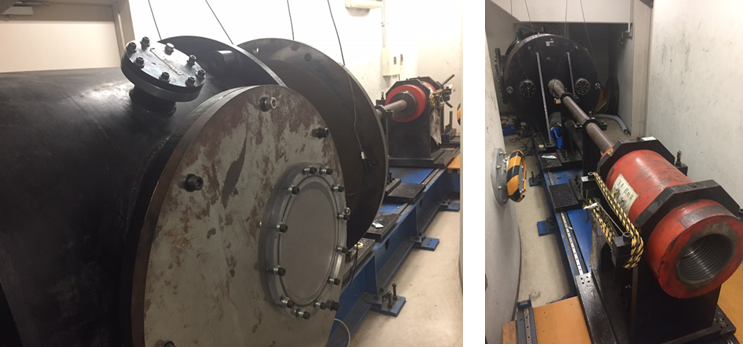
We operate a 40 mm-bore powder gun, which is a relatively large-caliber apparatus of its type. Combustion of the propellant accelerates a projectile to a velocity of approximately 1 km/s. By impacting the projectile against a specimen at high velocity, experiments can be conducted on high-rate deformation, shock compression, impact fracture, and high-velocity impact phenomena in metals, concrete, porous materials, and other materials.
Experiments are conducted after evacuating the target chamber to a pressure on the order of 10⁻³ kPa. As shown in the photographs, the target chamber has a large observation window, providing a wide field of view for high-speed imaging of the entire process from projectile impact to specimen deformation and fracture. The chamber is also equipped with BNC ports, allowing various measurements to be synchronized with high-speed imaging.
Pulsed High-Current Generator
Our laboratory operates a pulsed high-current generator manufactured by Nichicon Corporation. The system has a capacitance of 12.5 μF and a charging-voltage range of 10–40 kV, allowing it to store up to 10 kJ of electrical energy. When charged to 40 kV, the short-circuit current reaches approximately 100 kA about 10 μs after discharge initiation. The system is equipped with a high-voltage probe and a current monitor for measuring the voltage and current waveforms during discharge.
When a pulsed high current is passed through a metallic conductor, such as a fine wire or foil, rapid heating causes the conductor to melt and vaporize, producing an electrical explosion accompanied by a shock wave. This system is used to initiate energetic materials, evaluate and utilize the resulting shock waves, and conduct materials-synthesis experiments in which metallic conductors are converted into nanoparticles by electrical explosion.
Explosion Test Facility in an Online Commercial
This online commercial was filmed at our facility. The video provides a view inside the explosion pit and shows experiments being conducted.