
https://www.youtube.com/shorts/QbevXANUYlI
Explosive forming is a manufacturing process that uses the shock pressure generated by the detonation of an explosive to deform a metal plate extensively within an extremely short period. Approximately half a century ago, this process was used in the aerospace industry to form large components with complex curved surfaces. A key advantage of explosive forming is that it can produce shapes that would require large dies and extensive processing equipment in conventional press forming.
The YouTube video shows an example of explosive forming. Several metal plates are first welded together to form an approximately spherical vessel, which is then filled with water. When an explosive is detonated underwater inside the vessel, the resulting underwater shock wave acts on the inner surface and deforms the metal plates outward at high velocity. Because the pressure is transmitted throughout the vessel by the water, surface irregularities caused by welding and variations in the initial shape are smoothed out, producing a smooth metal sphere with a nearly perfect spherical shape.
Explosive forming is a manufacturing process that uses the shock pressure generated by the detonation of an explosive to deform a metal plate extensively within an extremely short period. Approximately half a century ago, this process was used in the aerospace industry to form large components with complex curved surfaces. A key advantage of explosive forming is that it can produce shapes that would require large dies and extensive processing equipment in conventional press forming.
The YouTube video shows an example of explosive forming. Several metal plates are first welded together to form an approximately spherical vessel, which is then filled with water. When an explosive is detonated underwater inside the vessel, the resulting underwater shock wave acts on the inner surface and deforms the metal plates outward at high velocity. Because the pressure is transmitted throughout the vessel by the water, surface irregularities caused by welding and variations in the initial shape are smoothed out, producing a smooth metal sphere with a nearly perfect spherical shape.
Explosive Forming Using a Die
In conventional press forming, a metal plate is placed between a matched upper and lower die and formed by applying pressure. In explosive forming, by contrast, the pressure generated by an underwater shock wave acts on the surface of the metal plate and serves the function of the upper die, as shown in the numerical-analysis animation.
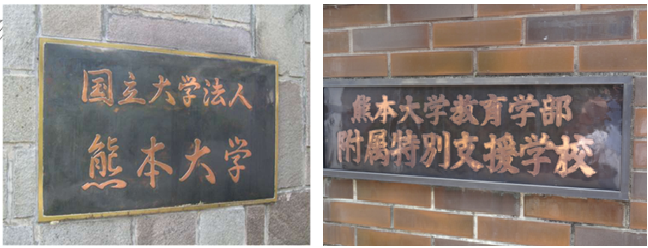
Explosive forming can also use relatively soft materials, such as plastics and paper, as dies. The Kumamoto University nameplates were fabricated by taking advantage of this characteristic. A handwritten original was digitized, and a cutting mat from which the characters had been removed along their outlines was used as the lower die. A thin copper sheet was placed over the die and subjected to an underwater shock wave. The copper sheet was driven at high velocity into the recessed character patterns. As a result, the character shapes of the lower die were transferred to the copper sheet, producing a nameplate with a three-dimensional relief pattern.
Microscale Forming Using a Bamboo Leaf as a Natural Mold
Explosive forming has a long history as a manufacturing process, but it has mainly been used to form large components. Consequently, little attention had previously been paid to how finely detailed a structure could be transferred using this process.
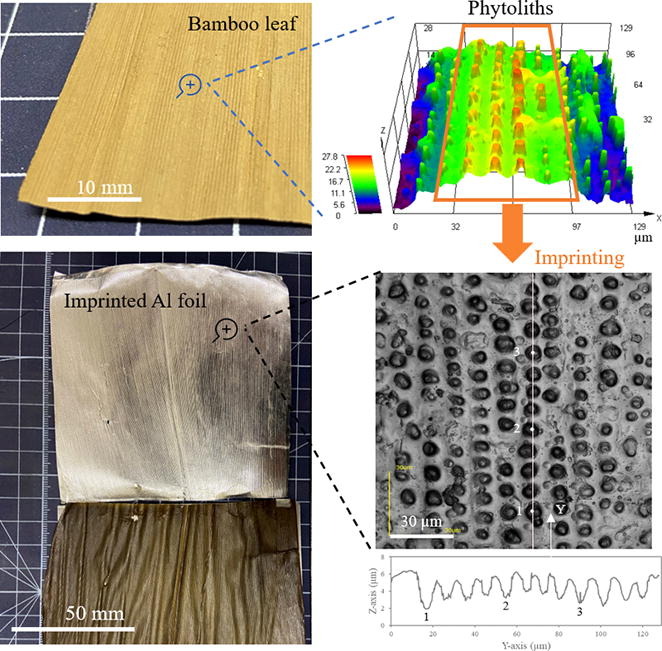
The surfaces of grass leaves contain microscopic protrusions that, together with surface waxes, contribute to their water-repellent properties. Laser-microscope observation of the bamboo leaf shown in the figure confirmed the presence of protrusions several micrometers in size. We therefore used the bamboo leaf as a natural mold, placed aluminum foil over it, and compressed the assembly using an underwater shock wave. After forming, microscopic depressions corresponding to the protrusions on the bamboo leaf were observed on the aluminum foil. These results demonstrated that explosive forming can transfer microscale surface structures found in nature [1].
[1] S. Tanaka, D. Inao, I. Bataev, A. Kubota, and K. Hokamoto, “Ultralarge-area shock imprinting using underwater shock wave and natural leaf mold,” Manufacturing Letters, Vol. 27, pp. 8–12, 2021. DOI: 10.1016/j.mfglet.2020.11.004.
Transfer of Fine Structures onto Metal Plate Surfaces Using a Polymer Stamper
One characteristic of explosive forming is that relatively soft materials can also be used as molds. Optical discs such as DVDs are made of polycarbonate and have fine periodic surface structures on the submicrometer scale.
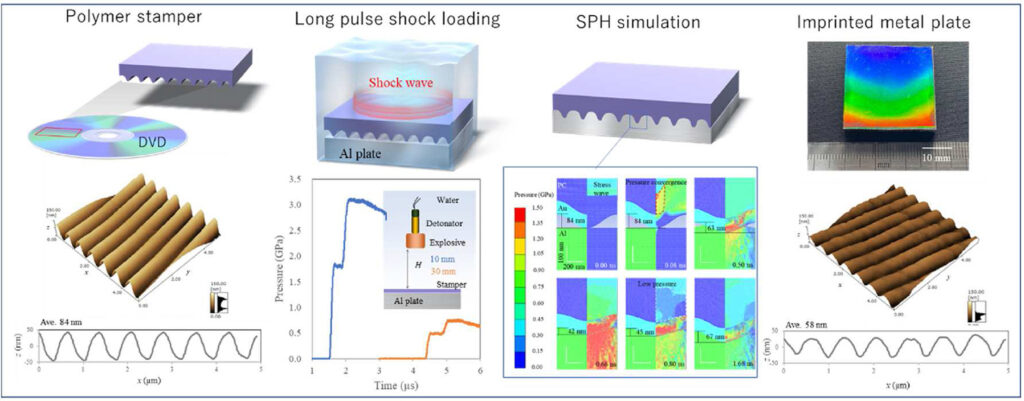
We previously conducted imprinting experiments in which aluminum foil was placed over a DVD used as the lower mold and compressed using an underwater shock wave. Although the mold was made of a soft polymer, grooves with a depth corresponding to approximately 90% of the groove depth on the DVD surface were formed in the aluminum foil. We also demonstrated large-area transfer of fine structures by optimizing the shape and arrangement of the explosive charge [2, 3].
In conventional explosive forming, a metal specimen is pressed against a stationary lower die. The specimens are therefore generally limited to thin sheets, and metal foils have mainly been used for transferring fine structures.
Subsequent investigations into the dynamic deformation behavior of polymers showed that, even when a polymer is extensively deformed by impact, it retains very little permanent plastic deformation and recovers toward its original shape, unlike metals [4]. Based on this finding, we developed a method in which a polymer mold, conventionally fixed as the lower die, is instead used as a stamper that is driven against a metal plate, specifically a 5 mm-thick aluminum plate. By dynamically compressing the polymer stamper using an underwater shock wave and pressing it against the metal surface, we demonstrated that submicrometer-scale structures can be transferred not only onto metal foils but also onto substantially thicker metal plates [5].
[2] S. Tanaka, K. Hasegawa, I. Bataev, A. Kubota, and K. Hokamoto, “Sub-micrometer and nanoscale imprinting on large-area foils using high-pressure underwater shock waves,” Materials & Design, Vol. 198, Article 109341, 2021. DOI: 10.1016/j.matdes.2020.109341.
[3] K. Hasegawa, S. Tanaka, I. Bataev, D. Inao, M. Nishi, A. Kubota, and K. Hokamoto, “One-dimensional nanoimprinting using linear explosives,” Materials & Design, Vol. 203, Article 109607, 2021. DOI: 10.1016/j.matdes.2021.109607.
[4] K. Hasegawa, S. Tanaka, I. Bataev, D. Inao, M. Nishi, A. Kubota, and K. Hokamoto, “Toward a Better Understanding of Shock Imprinting with Polymer Molds Using a Combination of Numerical Analysis and Experimental Research,” Materials, Vol. 15, No. 5, Article 1727, 2022. DOI: 10.3390/ma15051727.
[5] K. Hasegawa, S. Tanaka, D. Inao, M. Nishi, A. Kubota, and K. Hokamoto, “Dynamic compression of a polymer stamper using high-impulse underwater shock waves to imprint a sub-micrometer structure on a metal plate surface,” Journal of Materials Research and Technology, Vol. 24, pp. 6730–6738, 2023. DOI: 10.1016/j.jmrt.2023.04.248.
Transfer Mechanism Revealed by Numerical Analysis
The animation reproduces the process by which the fine structure of a polymer stamper is transferred onto an aluminum plate, based on numerical simulations performed using a supercomputer. Red represents the polycarbonate, and blue represents the metallic reflective film; together, these two components form the stamper. Green represents the aluminum plate being processed.
When the underwater shock wave is applied, the entire stamper is pressed strongly against the aluminum plate. At this stage, the polycarbonate protrusions are temporarily compressed, while the surface of the aluminum plate undergoes plastic deformation.
As stress waves are repeatedly reflected within the stamper, the compressive stress acting on the protrusions temporarily decreases. The compressed polycarbonate then tends to recover its original volume, causing the protrusions to rebound and press into the aluminum plate again. The animation shows that repeated compression and recovery progressively depress the central region of the aluminum plate while the surrounding material rises, gradually transferring the stamper geometry onto the metal surface.
Laser-generated shock waves act for only a short duration, whereas underwater shock waves continue to press the stamper against the aluminum plate for a comparatively long period. During this sustained loading, the stamper protrusions repeatedly press into the aluminum plate. This repeated indentation is an important factor that enables the transfer of fine surface structures.