
Impact Joining (Explosive Welding)
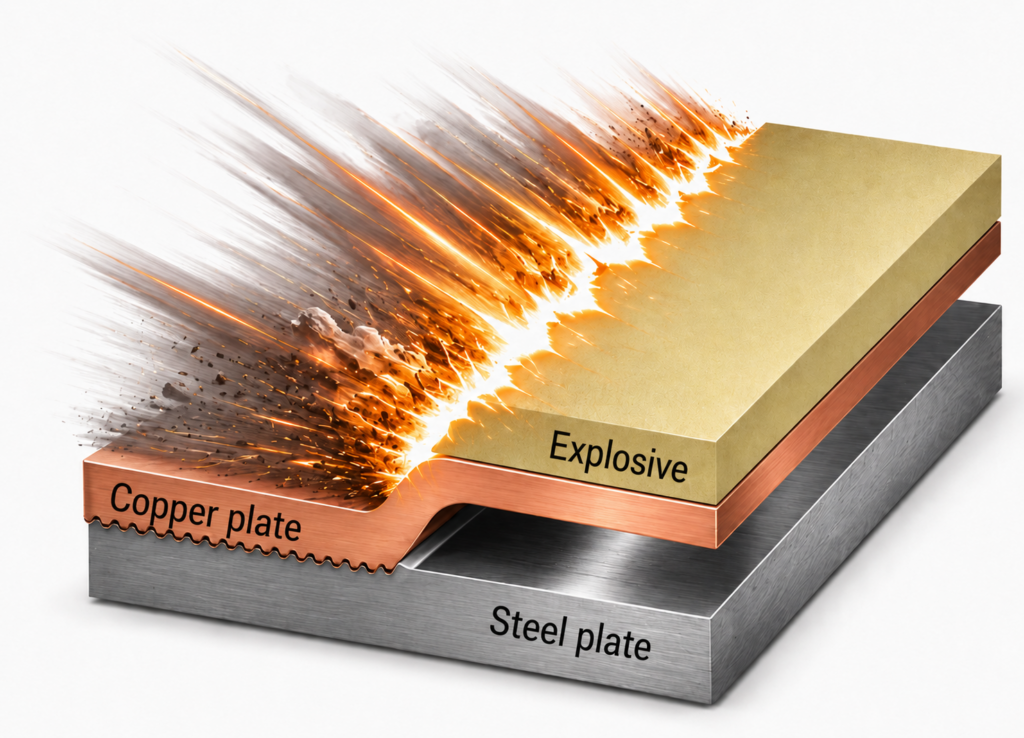
Explosive welding is a solid-state joining process in which one metal plate is accelerated to high velocity by the detonation of an explosive and made to collide obliquely with another metal plate. Because the plates are joined without melting the entire materials, dissimilar metals with substantially different melting points and thermal properties, which are difficult to join by conventional fusion welding, can be bonded over a large area.
In conventional fusion welding, the base materials or filler metal are melted to form a joint. Other processes, such as spot welding and seam welding, produce joints at discrete points or along lines. By contrast, a major advantage of explosive welding is its ability to join dissimilar metal plates over a broad surface area, enabling the production of clad materials.
The illustration shows a typical parallel arrangement for explosive welding of a copper plate to a steel plate. A specified stand-off distance is provided between the two plates, and an explosive layer is placed on the upper copper plate. When the explosive is initiated from one end, the copper plate is accelerated to high velocity and collides obliquely with the steel plate. This high-velocity oblique collision produces a strong bond between the copper and steel plates. Although copper and steel are shown here as an example, the process can be applied to many different combinations of metals.
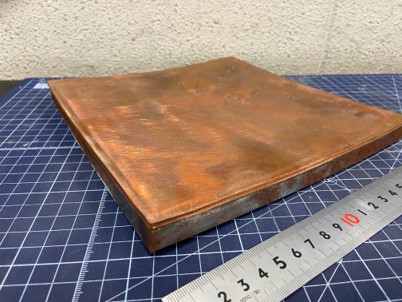
Depending on the welding conditions, a characteristic wavy morphology may form at the interface. For some material combinations and welding conditions, the bond strength can be sufficiently high that the base material, rather than the interface, fractures during mechanical testing. The process can also be scaled up to manufacture large-area clad materials. In Japan, large explosively welded clad plates are manufactured at Asahi Kasei’s Chikushino Plant.
Bonding Mechanism under High-Velocity Oblique Impact
The video shows a projectile impacting multiple thin metal sheets obliquely at high velocity using a powder gun. The projectile consists of a cylindrical ultra-high-molecular-weight polyethylene body with a diameter of 40 mm and a metal disk attached to its front face. The projectile is accelerated to approximately 400 m/s and sequentially impacts thin metal sheets arranged with specified stand-off distances.
At the instant of impact, a high-velocity ejecta flow accompanied by intense light emission emerges from the contact point between the metal disk and the thin sheet. This ejecta contains a metal jet expelled from the metal surfaces near the collision point. The metal jet removes oxide films and surface contaminants ahead of the collision point, thereby cleaning the metal surfaces to be joined.
At the same time, extremely high pressure is generated at the collision point, causing severe localized plastic flow of the metal surfaces. When the freshly cleaned metal surfaces, from which oxides and contaminants have been removed, are brought into intimate contact under high pressure, a strong bonding interface is formed.
Explosive-Free Impact Welding: VFAW
High-velocity oblique impact similar to that used in explosive welding can also be produced without explosives. One such process is Vaporizing Foil Actuator Welding (VFAW), which has been developed and advanced primarily by a research group at The Ohio State University.
In VFAW, a large pulsed current from a capacitor bank is passed through a thin aluminum foil. The foil is rapidly heated and explosively vaporized, generating high pressure. This pressure accelerates a thin metal sheet to high velocity and causes it to collide obliquely with the target material, producing a joint.
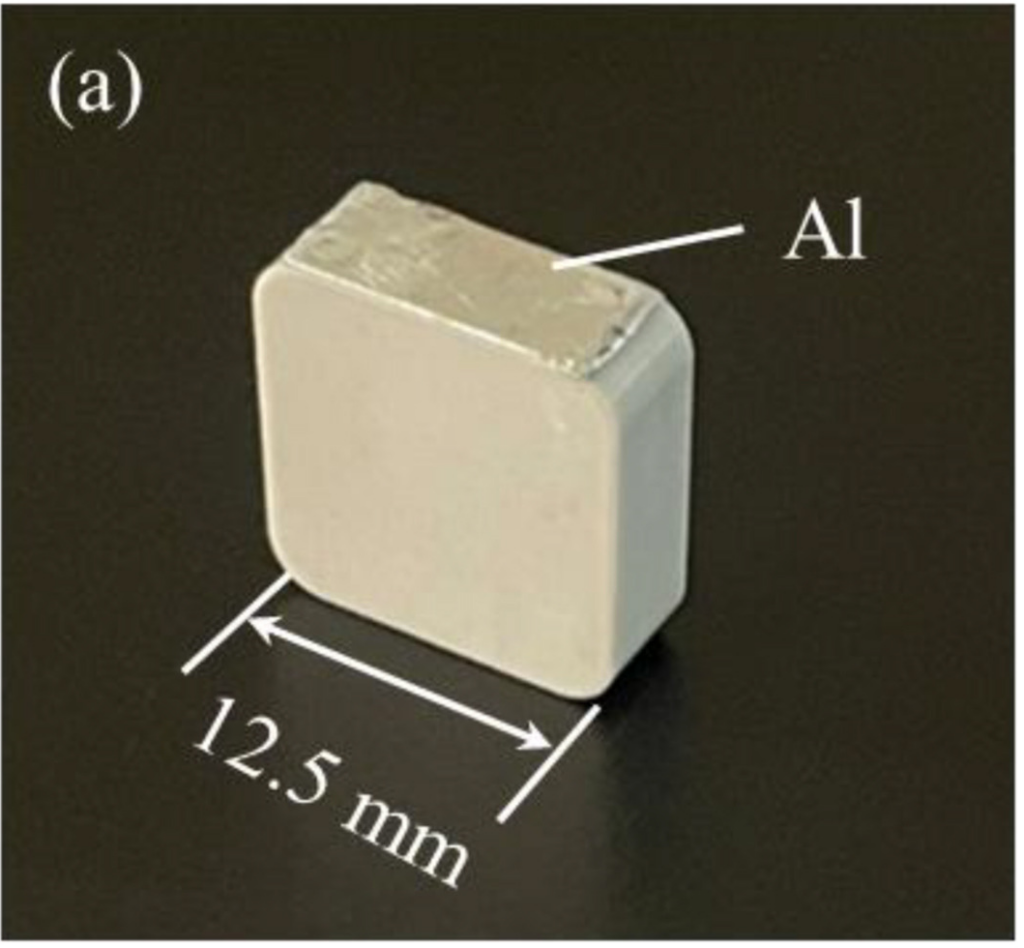
The photograph shows a specimen in which an aluminum sheet was joined to silicon nitride ceramic by VFAW. In explosive welding, the energy supplied to thin sheets or brittle ceramics can readily become excessive. Unless the impact is moderated using a pressure-transmitting medium or another method, localized melting of the thin sheet or fracture of the ceramic substrate may occur. In VFAW, however, the electrical energy supplied to the aluminum foil can be controlled, allowing the required collision velocity to be achieved while keeping the total energy acting on the specimen relatively low. Taking advantage of this characteristic, our study demonstrated that an aluminum sheet could be joined to silicon nitride without fracturing the ceramic substrate [1].
[1] R. Yamane, M. Nishi, H. Hamashima, H. Terasaki, M. Tokuda, K. Hokamoto, and S. Tanaka, “High-velocity impact bonding of aluminum sheet to ceramic substrate via Vaporizing Foil Actuator,” Journal of Materials Research and Technology, Vol. 41, pp. 1765–1775, 2026. DOI: 10.1016/j.jmrt.2025.12.298.
Hybrid Acceleration Using Electrical and Chemical Energy
In VFAW, the driving force obtainable from electrical energy alone is limited, which restricts the thickness and size of the metal plates that can be joined. Accelerating thicker and heavier plates requires larger capacitor banks and discharge circuits.
Even when the conductor geometry and discharge conditions are optimized, the energy consumed before the conductor undergoes electrical explosion is at most approximately 30% of the energy stored in the capacitor bank. Much of the remaining energy is consumed by the arc discharge that follows. In conventional VFAW, this arc discharge is not effectively used as a driving force for accelerating the flyer plate and therefore represents an energy loss.
Explosives can provide a much greater driving force, but there is also a limit to how thin the explosive layer can be made in order to reduce the explosive output. Every explosive has a critical thickness, which is the minimum thickness required to sustain detonation. In an explosive layer thinner than this critical value, the reaction does not propagate continuously into the remaining material, and therefore there is no risk of a self-sustaining detonation spreading through the layer. However, such a layer cannot release sufficient energy on its own and cannot ordinarily be used as a driving source for accelerating a flyer plate.
We therefore developed a hybrid acceleration technique that uses the arc discharge, previously regarded as an energy loss in VFAW, to induce the reaction of an explosive layer thinner than its critical detonation thickness [2]. A thin subcritical explosive layer is placed on a conductor, such as aluminum foil or metal mesh, and a pulsed high current is applied. The high-temperature arc and plasma generated after the electrical explosion of the conductor induce a reaction in the explosive, and the resulting chemical energy is used to accelerate the flyer plate.
This technique uses an arc discharge that would otherwise be lost to activate a subcritical explosive layer that, by itself, presents no risk of propagating detonation and has little value as a driving source. The chemical energy released by the induced reaction is thereby converted into useful driving force. As a result, the acceleration performance of the flyer plate was improved compared with that obtained using electrical explosion alone. Introducing energetic materials into manufacturing environments presents substantial practical challenges. Nevertheless, this research aims to establish a new processing technology that utilizes the high energy density of explosives while suppressing the risk of unintended explosion.
[2] R. Kawano, S. Tanaka, D. Inao, and K. Hokamoto, “Acceleration of metal plates by hybridization of electrical and chemical energy for potential application in high-velocity impact welding,” Journal of Materials Processing Technology, Vol. 318, Article 118014, 2023. DOI: 10.1016/j.jmatprotec.2023.118014.
Anchor-Based Joining of Polymer Sheets to Metals Using Underwater Shock Waves
A detonator is an initiation device used to start the reaction of an explosive. The detonator used in this study contains approximately 0.6 g of explosive. When activated underwater, it generates a strong underwater shock wave that propagates through the surrounding water. The video shows the shock wave generated by the detonator propagating spherically through the water.
An underwater shock wave is a rapidly propagating pressure disturbance generated by the reaction of an explosive. Because water has a much higher density than air, it can transmit explosive pressure to a material efficiently.
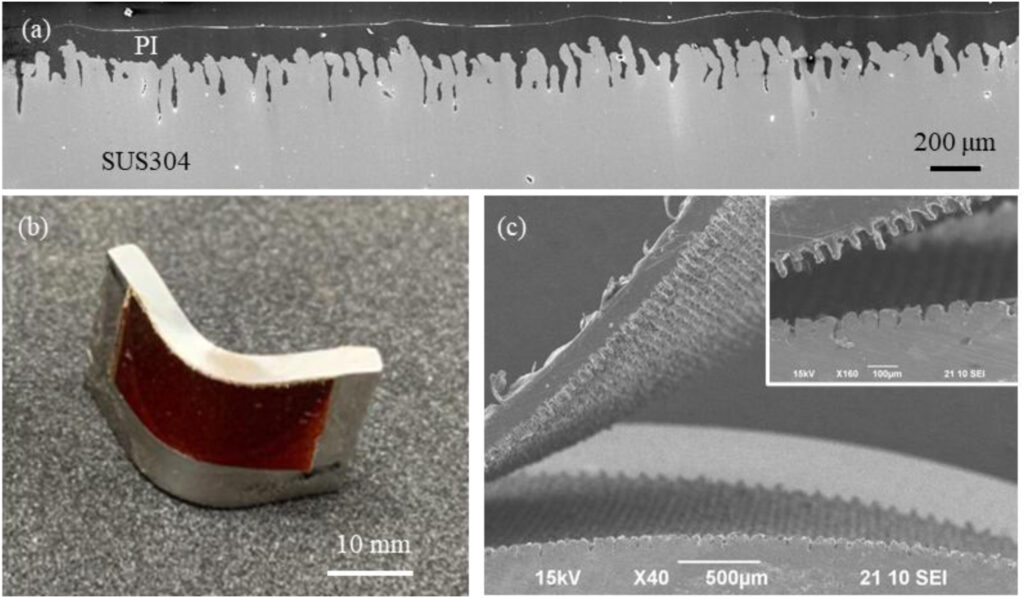
In this study, we developed a technique for mechanically joining a polymer sheet to a metal substrate using an underwater shock wave generated by a detonator. Fine grooves and surface irregularities are formed in advance on a stainless-steel substrate, and a polymer sheet is placed over the prepared surface. An underwater shock wave is then applied. Under the impact pressure, the polymer flows into the grooves on the metal surface and mechanically interlocks with them like an anchor, joining the two materials without adhesives or heating.
The figure shows a cross section of a polyimide sheet joined to a stainless-steel substrate. The polyimide penetrates deeply into the grooves on the substrate surface, forming a joint through mechanical interlocking. In addition to polyimide, the study demonstrated that the method can be applied to PTFE, a low-surface-energy material that is generally difficult to bond, and to polycarbonate [3].
In recent years, polymer sheets incorporating micro- and nanoscale surface structures have been developed to provide functions such as controlled optical properties and wettability. However, some polymers are poorly compatible with adhesives, and adhesive bonding processes may damage their functional surfaces.
With this technique, the polymer surface in contact with the metal substrate can be extensively deformed while the micro- or nanoscale structures on the opposite surface remain largely intact. Conventional dissimilar-material joining combines the properties of different materials. The novelty of this technique is that it can add the surface functionality of the polymer to that material combination. Future work will focus on joining functional polymer sheets to metal substrates.
[3] K. Hasegawa, T. Nishida, K. Kasamura, A. Kubota, H. Terasaki, K. Hokamoto, and S. Tanaka, “Mechanical bonding of dissimilar materials via anchor-based interfacial interlocking,” Journal of Materials Research and Technology, Vol. 39, pp. 6263–6274, 2025. DOI: 10.1016/j.jmrt.2025.10.127.